Protection and Confidentiality of Whistleblowers on Violations
|
The protection of witnesses and whistleblowers is vital in societies that aim to achieve justice and combat corruption. Saudi Arabia stands out as one of the countries that gives significant attention to the protection of witnesses and whistleblowers in order to maintain societal safety and promote the course of justice.
As witnesses and whistleblowers are cornerstone figures in the justice system, Saudi Arabia strives to provide a safe and encouraging environment for these individuals to report any violations or crimes without fear of retaliation or harm. The system in Saudi Arabia is considered a model for development and progress in promoting a culture of transparency and fighting corruption..
In Saudi Arabia, on 8/8/1445 AH, a royal decree (M/148) was issued approving the "Whistleblower, Witness, Expert, and Victim Protection System."
According to Article 8 of the system: "The Public Prosecutor may, if there is reason to believe that a whistleblower, witness, expert, or victim is at imminent risk, provide protection for them without their consent for a period not exceeding thirty (30) days. The Public Prosecutor may, when necessary, extend this period. The Public Prosecutor may, by written decision, delegate some of his powers to the heads of branches of the Public Prosecution."
According to Article 8 of the system: "The Public Prosecutor may, if there is reason to believe that a whistleblower, witness, expert, or victim is at imminent risk, provide protection for them without their consent for a period not exceeding thirty (30) days. The Public Prosecutor may, when necessary, extend this period. The Public Prosecutor may, by written decision, delegate some of his powers to the heads of branches of the Public Prosecution."
Article 14 of the system states the following:
A person covered by protection, as determined by the program management and in accordance with the protection procedures, shall be entitled to all or some of the following types of protection:
- Security protection.
- Concealing their personal data and any information that reveals their identity during the protection period.
- Relocation from their workplace – temporarily or permanently – in coordination with their employer.
- Assistance in obtaining alternative employment if it is necessary for them to leave their job.
- Providing legal, psychological, and social counseling.
- Providing means for immediate reporting of any danger to themselves or to anyone closely associated with them.
- Changing their phone numbers.
- Changing their place of residence temporarily or permanently and providing suitable alternatives, including relocating them to another area or city within the Kingdom, depending on the circumstances.
- Taking measures to ensure the safety of their transportation, including providing security escorts.
- Coordinating with relevant authorities to provide information related to the crime under protection using electronic means, while altering their voice and concealing their facial features.
- Protecting their residence.
- Providing financial assistance if being covered by protection affects their ability to earn a living.
- Any other types of protection deemed appropriate by the program management according to the regulations."
To view the "Whistleblower, Witness, Expert, and Victim Protection System," (Click here).
Since King Abdulaziz University is a government institution, it is committed to implementing all the laws and regulations approved by the state. Among these regulations are the policies, systems, and labor laws issued by the Ministry of Human Resources and Social Development, including the "New Employee Orientation Guide 2023 - 1444 AH," which applies to employees subject to the labor system and its executive regulations.
The "Anti-Corruption" section of the guide includes the following:
"The employee, in efforts to combat corruption, must:
1. Report in writing to their direct supervisor any violations of applicable laws and instructions that they become aware of during their work.
2. Report to the competent authorities any corruption they become aware of during their job.
3. Cooperate with the relevant authorities in administrative, financial, and criminal investigations.
4. Immediately inform their direct supervisor if offered a bribe, and the supervisor must take the necessary action, prepare a report on the incident, and notify the relevant authorities."
In the section titled "Government Entity Obligations Towards Public Employees," the regulations state:
"The government entity must:
1. Publish a code of conduct for public employees and ethics of public office on its website, inform the employee about it, and ensure that they are aware of their obligation to comply with its provisions.
2. Provide a safe and healthy work environment that meets the basic requirements for performing their duties."
This emphasizes the obligation of government sectors to protect their employees from any harm that may occur while enforcing laws and regulations. To view the guide, (Click here).
King Abdulaziz University places great importance on protecting whistleblowers of ethical violations by adopting policies and procedures aimed at ensuring the confidentiality of information and protecting the individuals reporting from any retaliation or harm.
For example, the university issued the "Code of Professional Ethics" for faculty members and those in equivalent positions, which includes clear commitments regarding ethical behavior in dealing with colleagues, students, and administration.To view the code, (Click here).
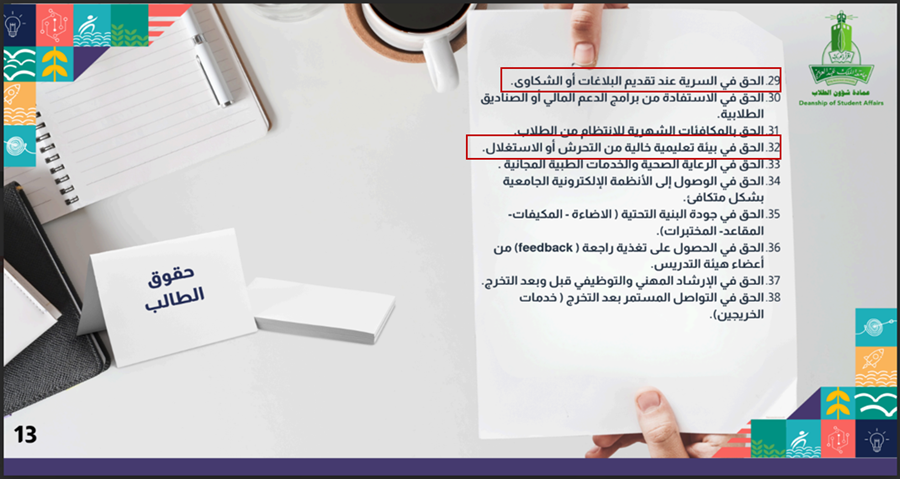
It includes the Student Rights and Responsibilities Guide at King Abdulaziz University, within the Student Rights section, a number of rights, including the following.
29 – The Right to Confidentiality When Submitting Reports or Complaints.
32 – The Right to an Educational Environment Free from Harassment or Exploitation.
To view more,
click here.
KAU has clear policies and procedures for members of staff to appeal against performance evaluation reports through a dedicated committee that looks at appealing requests made by staff members in addition to the online portal for staff complaints and appeals on the ministry of education webpage. Furthermore, the leadership evaluation process commences with initiating the evaluation request either by subordinates or leaders (down-top/top-down evaluation). Following the completion of the relevant evaluation form, the request is then sent to Deanship of Quality and Academic Accreditation for compilation and analysis of data. The results will then be sent to the relevant sectors followed by sending a copy to the evaluated leader. Finally, the evaluated leader will have the opportunity to appeal against the evaluation results within then days. In addition, DQAA created and designed a central surveys system that is run by a neutral body at the university so that the confidentiality and privacy of the results are preserved and safeguarded.
KAU is also committed to update its policies and procedures that deal with students’ disciplinary issues. Therefore, the University has formed a permanent committee that deals with student disciplinary procedures headed by the Dean of Students’ Affairs. This committee is well guided by the student’s behavior guides policy. Additionally, KAU has a well-established system that ensures
The protection of students’ rights through the formation of the Unit for the Protection of Student Rights which deals with the following aspects:
• Considering complaints and grievances made by students.
• Providing necessary advice to students regarding their academic and non-academic problems related to the university in a manner that does not conflict with the university’s rules and regulations
• Enlightening students about their rights and duties towards their university and how to obtain them by resorting to official channels inside the university
• Enabling students to object to the penalties issued against them
Grievance at KAU
KAU management has published its Professional Ethics Charter for staff. The charter defines the ethical and professional values the university embraces, such as justice, loyalty, integrity, the respect of confidentiality and privacy, equality, and honesty. The responsibilities and duties of staff are also included in the charter under ten different areas, where each KAU staff member is responsible for shaping the balanced character of their students through being a role model, demonstrating dedication and sincerity when performing their teaching role, and demonstrating integrity and originality of research work. Also, the charter defines the responsibilities and duties when dealing with students, colleagues and the university administration and facilities.
Within a similar scope, KAU also complies with the public job conduct rules. These rules present the generic definitions of the public job, career behaviour and general job ethics. Furthermore, the policy presents general prohibitions on the public sector employees’ and details prohibitions related to confidentiality of information and documents, public funds, privileges, and gifts.
KAU is also keen to develop mechanisms for grievances of faculty members and employees regarding promotions. A specialized committee has been established to examine grievances related to the job rights of university’s employees headed by the KAU’s Vice President and several Deans of Faculties and Institutes. The committee undertakes several tasks, including examining grievances for promotions submitted from University employees through the (Masar) platform, and consideration of the grievances to improve the situation and re-evaluation submitted by the University’s employees.
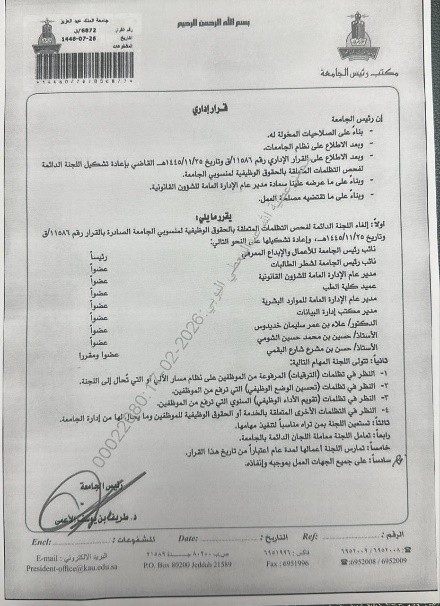
Employee Rights/ Appealing Process
The Ministry of Human Resources and Social Development in Saudi Arabia has developed a unified system for all employees in the Kingdom of Saudi Arabia called the MASAR platform. It is a national platform that provides a package of supportive and e-services to government agencies to develop their human resources with the aim of refining and developing the capabilities of the government employee.
1. Contribute to improving the government work system and raising it to international quality levels.
2. Upgrading the level of human resources services and investing in human capital.
3. Governance of procedures and systems in accordance with what is stated in the executive regulations for human resources.
4. Contribute to raising the efficiency and effectiveness of government agencies.
One of the most important services provided by MASAR platform to entities or individuals in universities is the ability to file and track grievances. This process is completely online, and users can check the status of their grievance at any time. This service can be used by students, faculty, staff, and other members of the university community to file grievances about a variety of issues, such as:
• Academic matters
• Financial matters
• Valuation reviews
• Discrimination and harassment
• Other workplace issues... etc.

Once a grievance is filed, it is automatically assigned to the appropriate university department for investigation. The department will gather additional information from the grievant and investigate the issue. The department will then issue a decision on the grievance, and the grievant will be notified of the decision. If the grievant is not satisfied with the decision, they can appeal the decision to the next level of the university administration.
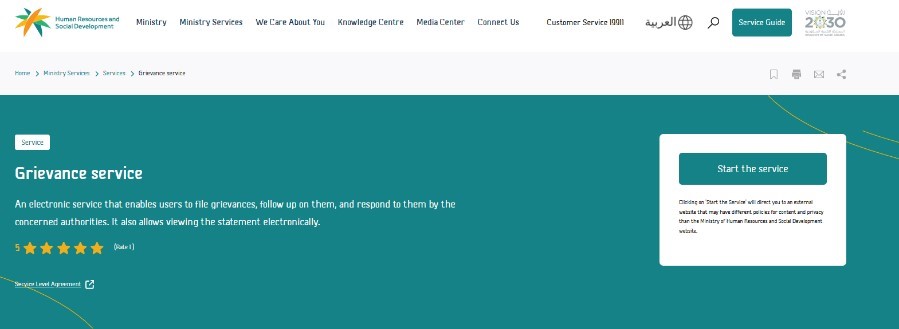
The Grievances in MASAR is a valuable tool for university communities that can help to improve communication, trust, and fairness.
KAU is following the Kingdom's example in caring for its employees and their rights by establishing a grievances system for its employees through the ANJEZ system. This system provides a platform for KAU employees to file and track grievances in a fair and transparent manner.
The ANJEZ system is a web-based system that allows KAU employees to file grievances anonymously or confidentially. The system also allows employees to track the status of their grievances and to receive updates from the university.
The system is an important tool for KAU employees because it provides them with a voice and a way to hold the university accountable for its actions. It also helps to ensure that KAU is a fair and equitable workplace for all employees.
|
Last Update
3/4/2026 11:23:17 AM
|
|