Equality, Diversity and Inclusion (EDI) policy
|
Equality, Diversity and Inclusion (EDI) policy
King Abdulaziz University is committed to achieving the objectives of the Kingdom of Saudi Arabia’s Vision 2030 and applies all applicable regulations and laws in force in the Kingdom that support the principles of justice, equality, and equal opportunity. The University also contributes to fostering an inclusive educational and work environment based on respect for diversity and the preservation of human dignity.
In this context, King Abdulaziz University has an Anti-Discrimination Policy, in accordance with the laws and regulations of the Kingdom, as follows:
Guidance Manual for Work Ethics Rules:
This manual aims to improve professional working relationships, making the work environment more attractive, leading to increased individual productivity, better business management, and enhanced trust among stakeholders. The guidelines emphasize the importance of adhering to the principle of equality in all situations in a fair and professional manner, regardless of race, color, or religion of any worker. (Click here)
Code of Professional Ethics for Faculty Members and Those in Their Position at King Abdulaziz University:
The administration of King Abdulaziz University has published the Code of Professional Ethics for faculty members. This code defines the ethical and professional values adopted by the university, such as justice, loyalty, integrity, respect for confidentiality and privacy, equality, and honesty.
The responsibilities and duties of faculty members are also outlined in the code under ten different areas. Each faculty member at King Abdulaziz University is responsible for shaping the balanced character of their students by being a role model, showing dedication and sincerity in their teaching role, and demonstrating integrity and authenticity in research work. The code also defines the responsibilities and duties when dealing with students, colleagues, university administration, and facilities.
Principle 5 under sub-section “Students & Tests” which is listed under “Obligations & Responsibilities” section, page
17, requests that the faculty member “considers the individual differences and awareness of the nature of students and their various characteristics and personalities, during his work”.
Principle 1 under sub-section “Peer Faculty Members & Administration” which is listed under the “Obligations & Responsibilities” section, page 19, requests that the faculty member “demonstrates the ethical anti-discrimination behavior of Islam and morals when dealing with the administration, colleagues, students, and all university employees”.
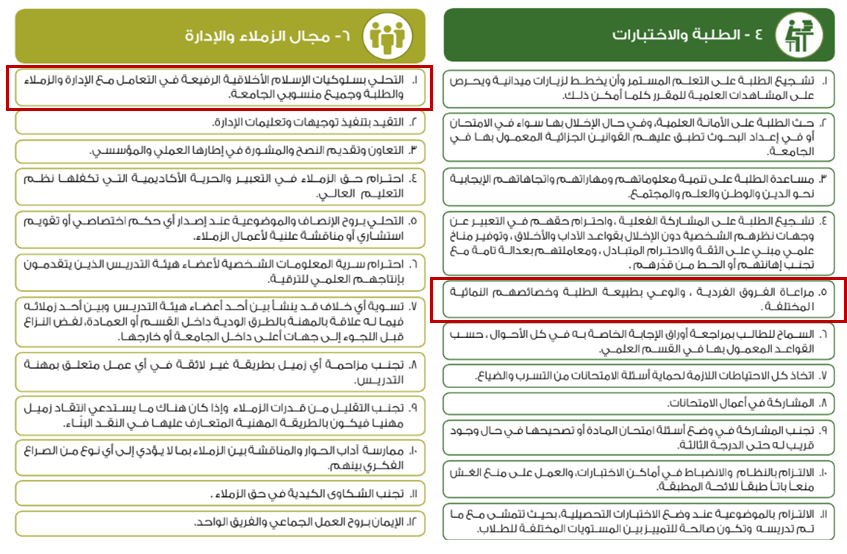
Principle 19
under sub-section “University” which is listed under the “Obligations & Responsibilities” section, page 22, requests the faculty member “to commit to seek and contribute to preventing all kinds of discrimination against any person or group on the basis of race, color, sex, age, religion, political belief, disabilities in its various categories, personal preferences, and social status or standing”.

Fore More
Non-Discrimination Policy Against Women, Gender
King Abdulaziz University abides with Kingdom's Vision (2030) and strives to achieve its goals.The women’s rights have received great attention from the government of Saudi Arabia by dedicating one of Vision 2030’s goals (ensuring an increase in women's participation labor market) considering it a strength area within the country.
In this regards, King Abdulaziz University ensured women empowerment in their representation in leadership positions, as women represent (50%) of the leaders at KAU.
On January 2, 2024, and in line with the principle of equal educational and research opportunities, the Council of King Abdulaziz University approved that both male and female students will be accepted equally in all available programs, based on the needs of the labor market. Admission will be in accordance with the regulations set by the concerned colleges and institutes, starting from the first semester of the academic year (1446 AH). To view the details of the news, click here.
Labor Law (Published on: February 18, 2025 - 19 Sha'ban 1446 AH)
- Chapter 9 addresses the employment of women and all rights and responsibilities related to that.
- Chapter 2 addresses the employment of individuals with disabilities and all rights and responsibilities related to that.
For More Details
Providing Equal Opportunities
The 2030 Vision further serves SDG5 by focusing on "providing opportunities for everyone - men and women, young and old - so they may contribute to the best of their abilities".
"Saudi women are yet another great asset. With over 50 percent of Saudi university graduates being female, the government will continue to develop their talents, invest in their productive capabilities and enable them to strengthen their future and contribute to the development of the society and economy".
The government issued and still amending its various laws to tackle the issue of discrimination in general, and gender discrimination in specific. KAU, applies all laws and regulations that are issued by the government and further defines its internal version of such rules' application within the university.
Prohibiting Wage Discrimination
On page 51, of the Implementing Regulations of the Labor Law, which is issued in November 2019, under Article 34, point 2, it is mentioned that:Wage discrimination between male and female workers performing equal work is prohibited.
Women’s Empowerment
In line with Saudi Arabia’s Vision 2030 and its programs, the issue of women's empowerment has received significant attention from the Saudi government, as well as relevant entities, including the Ministry of Human Resources and Social Development. One of the Vision’s goals is to ensure increased participation of women in the labor market. As a result, the steps taken by Saudi women towards empowerment have accelerated, thanks to numerous decisions, legislations, and regulations that enhance their position in society. Women have thus become active partners in national development across various fields: economic, social, scientific, cultural, and more, at all levels.
Some of the key efforts made by the Ministry of Human Resources and Social Development to empower women in the labor market include:
Initiative for Empowering Women in the Civil Service and Strengthening Their Leadership Roles:
This initiative contributes to increasing women's participation in all government sectors at all job levels by utilizing their skills, expanding their work options, and enhancing their participation to ensure equal opportunities between genders. It also allows women to hold high structural leadership positions within government agencies.
Initiatives to Empower Women to Enter the Labor Market:
Supporting Inclusion and Diversity in the Labor Market:
This initiative aims to create a work environment that values the differences among workers to reduce disparities in working conditions and opportunities by:
- Supporting the creation of an inclusive and supportive environment to ease women's entry into the labor market.
Awareness of Policies Related to Women in the Labor Market:
This initiative aims to review policies, update relevant regulations, and design training programs that target empowering women to enter the labor market, followed by launching awareness campaigns to support this goal
Encouraging Career Development for Women:
This contributes to identifying potential career advancement tools for women and analyzing their effectiveness and impact.
Developing Regulatory Legislation to Support Women in the Workforce:
This initiative aims to develop legislation, regulations, and systems that improve the physical work environment and address obstacles that hinder women's work participation.
Leadership Training and Guidance Initiative:
This initiative aims to increase the percentage of women in middle and senior leadership positions in line with the goal of increasing women’s participation in the labor market. It focuses on training women in various sectors, both public and private, to provide them with an ideal environment that enables them to access information that enriches their knowledge and equips them with everything they need to become role models to be proud of.
Encouraging Remote Work Initiative:
The initiative seeks to develop an innovative operational model that aligns with the program's vision of enhancing human resource development and productivity. It expands women’s options to gain knowledge, skills, and experience, while providing appropriate and productive job opportunities for national labor, thus reducing unemployment. It also aims to increase employment rates among job seekers, particularly women and people with disabilities in various regions of the Kingdom, contributing to the achievement of the Ministry's strategic goals.
Encouraging Flexible Work Initiative:
This initiative increases job opportunities for Saudi men and women, especially those living in less-developed areas with limited educational backgrounds. It also promotes economic growth and diversifies available job opportunities by developing comprehensive flexible work (hourly work) laws and encouraging employers to provide flexible work contracts (hourly).
Qurra - Providing Childcare Services for Working Women:
The Qurra initiative aims to create a bridge between childcare centers and parents looking to enroll their children. It supports empowering working women to join and remain in the labor market by developing and organizing this sector through services for childcare centers, nurseries, and kindergartens.
Wasoul - Supporting and Facilitating Women’s Transportation:
This initiative aims to empower women to work in the private sector and increase their participation in the labor market by helping employees overcome transportation difficulties to and from work, thus supporting their job stability. The program is financially supported by the Human Resources Development Fund (HRDF) and collaborates with ride-hailing apps to provide high-quality transportation services at an affordable cost.
For more information, click here.
Ministerial decree number 39860
Ministerial decree number 39860 issued in 2018, decided the following important rules and regulations regarding the discrimination against women in the work domains and the workplaces. The Ministry of Labor and Social Development stressed the need for employers and workers in the private sector to comply with the unified organization of the working environment for women, which aims to create an attractive working environment for women and enable them to work in various labor market activities, while maintaining their privacy at work.
The ministry pointed to its keenness through this organization to open several areas for women's work while providing an attractive and safe work environment for women's work and stability.
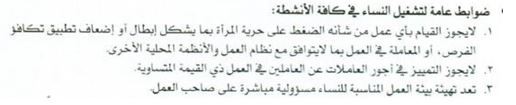
The related decisions can be fetched from page 4:
-
It is forbidden to do any work that could affect women’s freedom which could slow or stop work equality or discrimination in treatment at work which will be against the Labor Law and other regulations.
-
It is forbidden to discriminate between genders regarding their wages in jobs which have similar profiles.
-
The organization is responsible to provide adequate working environment for women.
The Ministry stressed that any enterprise that violates the provisions of the regulation will be subject to the penalties imposed by the Labor Law and relevant ministerial decisions, stressing that it will not be negligent in following up the commitment of the establishments to organize and implement the legal procedures in their right.
Fore More
Discrimination Reporting Protection Policy Executive Regulations of the Law of Protection from Abuse
The National Protection from Abuse law, issued in 2013, handles all issue related to the different types of abuse. Article 5, of the Executive Regulations of the Abuse Law, talks about protecting people who claim abuse or discrimination incidents.
“Abuse” is defined as: “every form of discrimination, physical or psychological abuse or sexual abuse or threat thereof committed by a person towards another person,
Article (5) The confidentiality of identity of a person reporting a case of abuse shall be maintained, and may not be disclosed except with his written consent and only as needed. The following cases shall be excluded:
5.A If the Social Protection Unit deems that the disclosure of the identity of a person reporting a case is necessary for substantial reasons determined by the Multidisciplinary Team handling the case , provided that this is within the minimal limits.5.B The Social Protection Unit shall not reveal the identity of a person who reports abuse to the official authorities except upon receiving a formal justified request from the requesting entity. The requesting entity shall maintain the confidentiality of the identity of the reporting person, and shall not compromise in its disclosure. Anyone who violates this provision shall be held responsible for this disclosure.
Fore More
The Anti-Harassment Crime System
KSA’s Anti-Harassment Law came into effect on 8 June 2018 and makes it a criminal offence (punishable by a fine and/or imprisonment) for anyone to harass another by any statement, act or signal of a sexual nature by whatever means, including the use of modern technology.
Saudi Arabia Cabinet Decision No. 488/1439 defines ‘harassment’ as verbal, physical, or sexual innuendo by one individual against another (including through social media) targeting that individual in any manner.
The Anti-Harassment Law also applies in the workplace. The law specifically requires employers to develop measures to combat harassment in the workplace by putting in place complaint mechanisms and raising awareness amongst employees of the measures that the employer will take to combat harassment. Employers are also required to hold their employees
accountable if they breach any provisions of the Anti-Harassment Law. Individuals suffering from or witnessing harassment are obliged to report the allegations to the concerned authorities. All organizations (particularly within an employment context) are under an obligation to take steps to prevent harassment from occurring. It is important to note that this law does not just protect women. It also cover men with a particular attention to minors under 18 and people with special needs.
KAU, as a public university, abides by and applies the Anti-Harassment Policy within its premises.

King Abdulaziz University is committed to the rules and regulations issued by the Ministry of Human Resources and Civil Service, including the ministerial decision to adopt controls for protection against behavioral attacks in the work environment, which aim to preserve the individual’s privacy, dignity and personal freedom.
The decision indicated that what is meant by behavioral aggression (abuse) is all practices of abuse by one party against another party, including all forms of exploitation, threats, harassment, blackmail, temptation, quarreling, cursing, humiliation, insinuating something that violates modesty.KAU has clearly defined rights, responsibilities, and bylaws to control students’ behaviour within the campus.KAU’s student values guide: It aims to introduce students to a set of priority ethical values for university students, highlighting their importance and positive impact on the student. The guide includes recommendations to faculty member on how to reinforce and enhance these values for students.
Fore More
|
Last Update
3/4/2026 11:39:02 AM
|
|